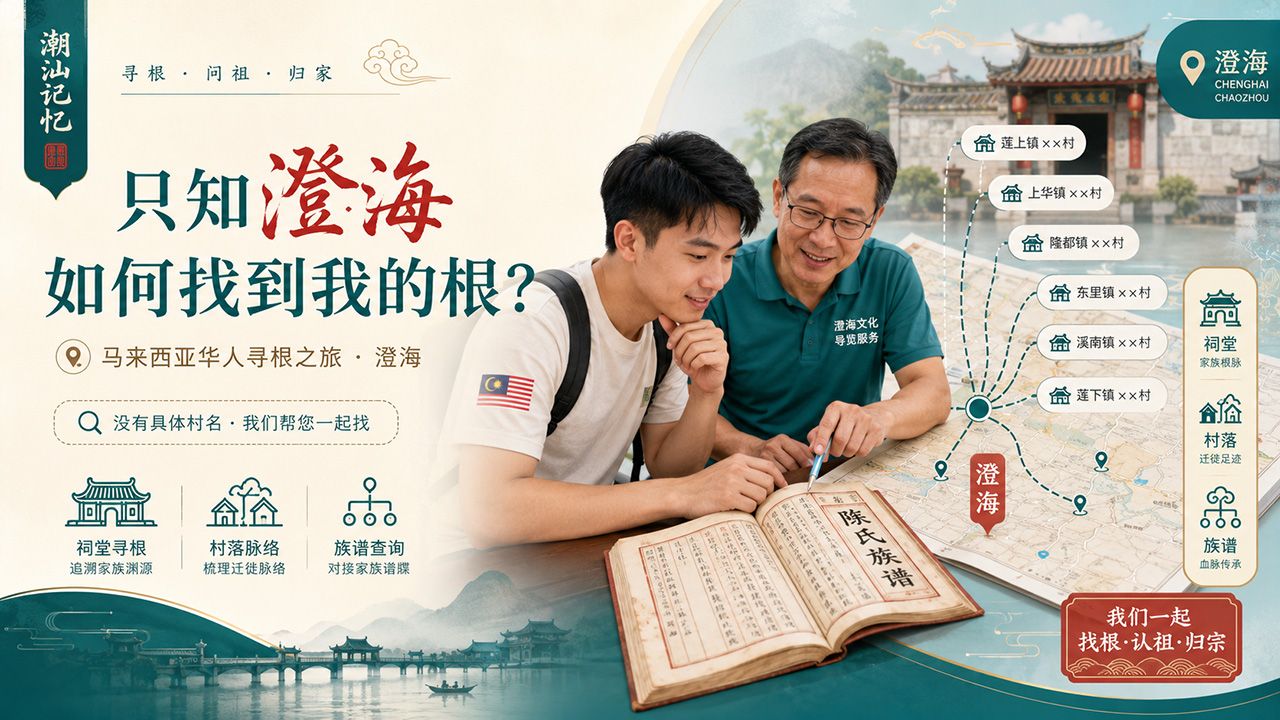
Bespoke Chaoshan tours for visitors from Singapore & Malaysia
Malaysian Chinese only know their ancestral home is in Chaozhou Chenghai, but not the specific village. How to find locals to help with root-seeking and genealogy checking?
Chaoshan Root-Seeking / Overseas Chinese Information / Chenghai Tourism

Malaysian Chinese only know their ancestral home is in Chaozhou Chenghai, but not the specific village. How to find locals to help with root-seeking and genealogy checking?

2026-06-08 Chaoshan Travel Information Network Editorial Department

Essential Preparation Checklist Before Root-Seeking

Root-seeking: Do not blindly return to China directly! Before departure, be sure to collect the following information at your home in Malaysia and take photos/scans: Ancestors' real Chinese names (including courtesy names and aliases). Inscriptions on tombstones (usually engraved with old place names from the Qing Dynasty/Republic of China period, such as "Chenghai XX Township"). Ancestral tablet (spirit tablet) information on native place. Old letters or "Qiaopi" (the domestic recipient address on the envelope is the ultimate clue!).

##ChaoshanRootSeekingGuide##ChenghaiQiaolian##QiaopiInterpretation##GenealogyQuery

A tree may grow a thousand feet tall, but its leaves return to the roots. Every yellowed Qiaopi, every tombstone engraved with ancestral origin, is a coordinate guiding overseas wanderers across a century of time and space to find their Chaoshan homeland.

Many Malaysian Chinese, after the passing of their elders, only retain vague ancestral home memories such as "Guangdong Province, Chaozhou Prefecture, Haiyang County/Chenghai County." Facing the dilemma of no specific village information, this article provides a systematic and practical Chaoshan root-seeking guide: from collecting "Qiaopi" and tombstone clues, to contacting the Chenghai District Federation of Returned Overseas Chinese in Shantou City, to leveraging clan associations and local guides, helping you cross the ocean and fulfill your dream of root-seeking and genealogy checking.

Key highlights

  • Clue Tracing: Teach you how to extract core root-seeking codes from ancestral tablets, tombstones, and old photos.
  • Administrative Division Pitfall Avoidance: Clarify the historical change of "Chaozhou Chenghai" belonging to "Shantou City" in modern administrative divisions.
  • Official Authority Contact: Provide the correct process for contacting the local "Overseas Chinese Affairs Bureau" and "Federation of Returned Overseas Chinese."
  • Civil Clan Power: How to utilize the strong "surname clan associations" and ancestral hall genealogy networks in the Chaoshan region.
  • Field Guide Assistance: Find reliable local Chaoshan guides and escorts to overcome dialect barriers for field visits.
For many Malaysian Chinese, due to their ancestors going to Southeast Asia in early years, family memories have gradually blurred through historical changes. Many descendants only know the oral tradition of "ancestral home in Chaozhou Chenghai" but do not know the specific village, making the root-seeking journey seem like looking for a needle in a haystack.
In fact, as long as you master the correct methods and channels, with the help of locals, the success rate of recovering genealogies and recognizing ancestors is very high. Below are the systematic root-seeking steps compiled for you:
Step 1: Clarify Historical Place Name Changes (Very Critical)
The "Chaozhou Chenghai" mentioned by overseas Chinese usually refers to the administrative division of the Qing Dynasty or the Republic of China (Chenghai County, Chaozhou Prefecture). However, in modern administrative divisions, Chenghai currently belongs to Shantou City, Guangdong Province (i.e., Chenghai District, Shantou City). Before starting the search, clarifying this geographical attribution can help you avoid detours when searching online and contacting official agencies. 👉 Click to understand the administrative division relationship of the three Chaoshan cities: modern Shantou, Chaozhou, and Jieyang
Step 2: Dig Deep into Overseas Clues (Qiaopi and Tombstones are Golden Keys)
Even if you don't know the village, the relics left by your ancestors must contain clues.
Qiaopi: The remittance slips and family letters sent back to China by early overseas Chinese are called "Qiaopi." The envelope usually states "Chenghai County, XX Du, XX Township," which is the most precise location address. 👉Learn about the Memory of the World Register - the history and interpretation role of the Shantou Qiaopi Cultural Relics Museum
Tombstones and Ancestral Tablets: When traditional Chaoshan overseas Chinese are buried in Malaysia, the top of the tombstone often bears the name of their hometown (such as "Longdu," "Fengxiang," "Zhanglin," etc., which are old town/township names of Chenghai).
Step 3: Seek Official Help - Contact the Chenghai District Federation of Returned Overseas Chinese
Chinese governments at all levels have specialized agencies serving overseas compatriots - the Federation of Returned Overseas Chinese (Qiaolian). For overseas Chinese lacking specific village information, the most authoritative first stop is to contact the Chenghai District Federation of Returned Overseas Chinese in Shantou City. You can send the collected information such as ancestors' names, old place names, and fragments of genealogies to them via email or phone. The Qiaolian staff are familiar with local historical changes and can help you match possible villages in massive data through local chronicles and township Qiaolian branches. 👉 Shantou City Federation of Returned Overseas Chinese
Step 4: Leverage Civil Forces - Clan Associations and Genealogy Networks
The Chaoshan region has a strong clan concept; almost every large village has its own ancestral hall and complete genealogy. Famous surname clans in Chenghai, such as Chen, Lin, Cai, Wang, etc., have very large and active clan associations.
Operation Method: If you know your ancestor's surname, you can connect with the corresponding surname clan association in Chenghai through the local Chaozhou Guildhall in Malaysia. The elders of the clan association are usually very familiar with the generational names (zibei) of each village. Once the generational name matches, you can likely determine which village branch it is, and then look through the village genealogy to find your grandfather/great-grandfather's name.
Step 5: Hire Local Guides and Conduct Field Visits
When the clues narrow down to a few suspected villages, field visits are necessary. Since elderly people in Chaoshan villages mostly speak only Teochew, and old place names differ from modern navigation, finding a local guide (dìpéi) familiar with Chenghai local customs and proficient in both Teochew and Mandarin is crucial. The guide can help you:
Visit the village committees to check old household registration records.
Communicate smoothly with the elderly who manage the ancestral halls (usually the keepers of genealogies).
After successful root-seeking, assist in arranging ancestor worship ceremonies. 👉 Book professional Chaoshan local root-seeking guide and charter car transfer service, we will assign a local expert well-versed in Chaoshan clan culture to escort you throughout the journey.

Further reading