Chaoshan Temple Worship Pitfall Guide: Quick Reference on Temple Entry Rules, Donations, and Folk Taboos
Quick answers
- Never step on the threshold: In traditional culture, the threshold represents the shoulders of the deity or the dignity of a well-matched family. You must step over it when entering or exiting, and absolutely must not step on it.
- Enter left, exit right: Facing the main gate of the temple, the rule is 'enter through the Dragon Gate (right side door), exit through the Tiger's Mouth (left side door).' Generally, do not use the central door.
- Do not blow out incense with your mouth: If there is an open flame after lighting incense, gently fan it out with your hand or shake it out up and down. Blowing it out with your mouth is considered disrespectful to the deity (as it carries worldly impure breath).
- Insert incense with the left hand: Traditionally, the right hand is associated with killing and rough work, while the left hand is relatively clean. Therefore, whether holding incense or inserting it into the incense burner, the left hand should be used primarily.
- Photography taboos: You may photograph the temple's exterior architecture and carvings, but it is strictly forbidden to point the camera directly at close-ups of deity statues' faces, and do not take photos with the deity.
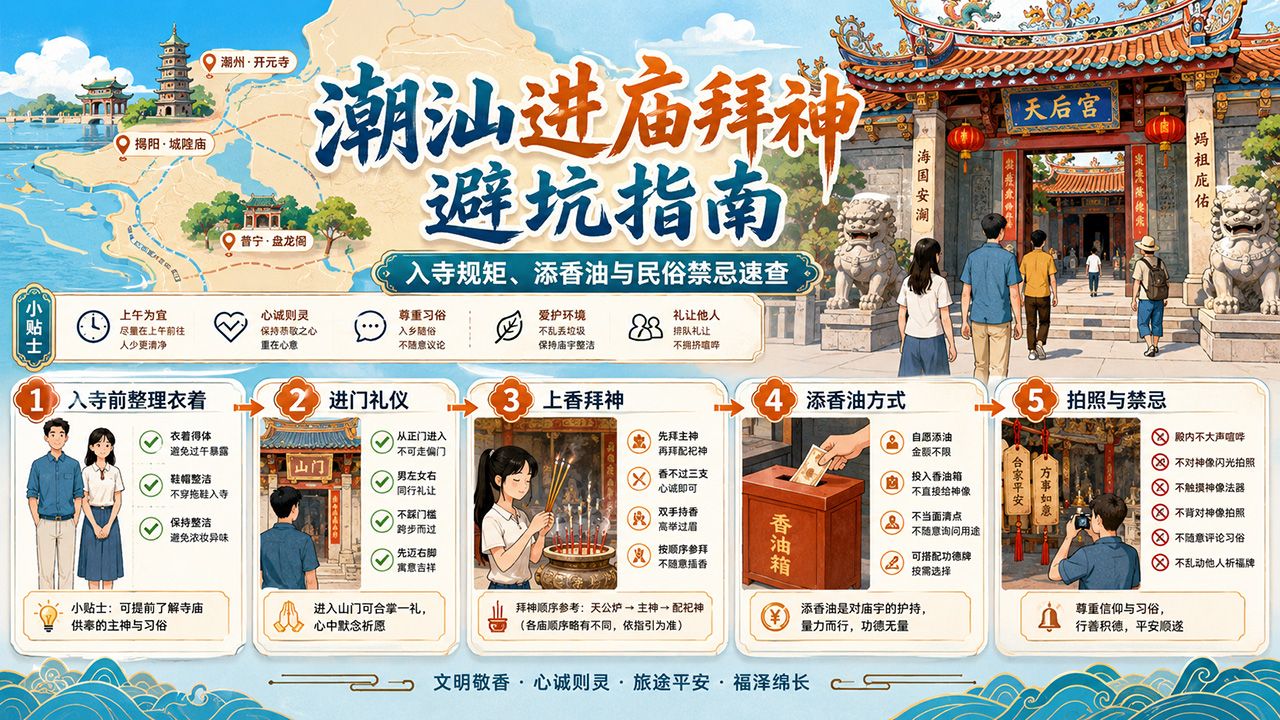
- Entry Rules: Stepping Over the Threshold and the 'Left-Right' Way
- Donations and Fortune Sticks: Go with the Flow, Beware of 'Sky-High' Fees
- Chaoshan Characteristics: Besides Buddha, Which 'Lords' Should You Worship?
- Dress Code and Menstruation Taboos
Chaoshan Core Temple/Shrine Visit Guide
← 左右滑动查看完整表格 →
| Temple Name | City | Core Deity/Belief | Focus of Prayers | Visit Tips | ||||
|---|---|---|---|---|
| Chaozhou Kaiyuan Temple | Chaozhou Ancient City Area | Buddhism (Shakyamuni, Guanyin) | Pray for safe travels and family well-being | The first ancient temple in eastern Guangdong, Tang Dynasty architectural style. Must-see: the exquisite Chaozhou wood carvings inside the hall. |
| Qinglong Ancient Temple (Anji Wang Temple) | By the Han River, Chaozhou City | Anji Shengwang (Local Deity) | Pray for business prosperity and good fortune | One of the most popular temples in Chaozhou. The 'embedded porcelain' art on the roof is a masterpiece. |
| Shantou Mazu Temple | Near Shantou Small Park | Mazu (Sea Goddess) | Pray for safe voyages and smooth overseas travel | A must-visit for those tracing roots to Nanyang. Across the street, you can also try the famous Mazu Temple zongzi (glutinous rice dumplings). |
| Chaoyang Lingshan Temple | Chaoyang District, Shantou City | Buddhism (Master Dadian) | Pray for academic progress and career success | Rich in history, with cultural ties between Han Yu and Master Dadian. |
FAQ
Q:I don't know how to hold incense or recite prayers. What should I do?
A:In terms of action, hold the incense with both hands above your head (or at eyebrow level), silently recite your name, date of birth, and current address (so the deity knows who you are), then state your wish. Chaoshan deities 'understand multiple languages'; silently reciting in Mandarin or English works just as well.
Q:Can I use my own incense?
A:For environmental and fire safety reasons, most core temples in Chaoshan (such as Kaiyuan Temple) now prohibit visitors from bringing their own incense and candles (known as 'banning high incense'). The temple usually provides three sticks of incense for free, or has a designated incense counter. It is recommended to obtain them directly inside the temple.
Q:Can I take away the offerings (such as fruit or cookies) after worship?
A:If the offerings are ones you brought yourself, after the incense has burned more than halfway, you should bow to the deity with hands clasped, and then you can take them away to eat. In Chaoshan custom, eating offerings that have been presented to the deity can 'ensure safety.' But remember, you absolutely cannot take offerings placed on the altar by others.