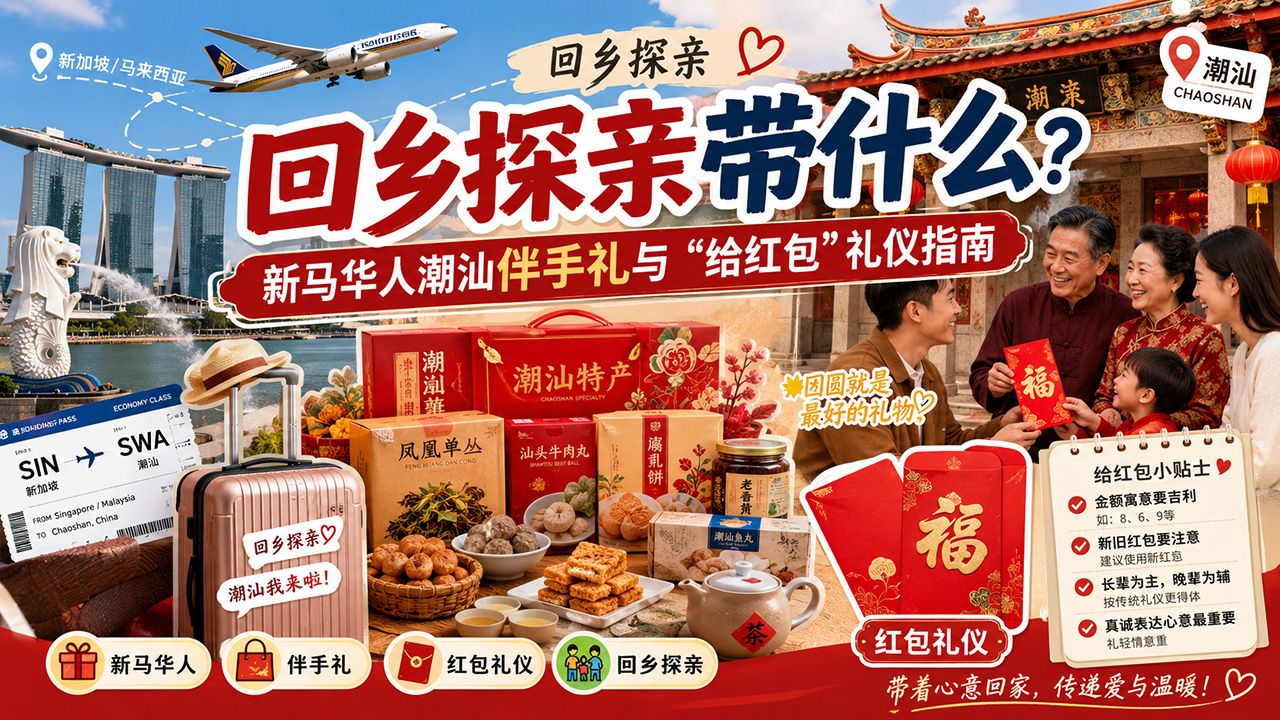
What to Bring When Visiting Hometown? A Guide to Chaoshan Souvenirs and 'Giving Red Envelopes' Etiquette for Singapore/Malaysian Chinese
Quick answers
- Sincerity matters more than expense: Chaoshan relatives value 'Nanyang characteristics' and practicality, rather than blindly competing over luxury goods.
- Medicated oils and coffee are the safest bets: Singapore and Malaysia's Qianli Zhuifeng Oil, white coffee, bird's nest, etc., are still the favorite 'old-fashioned flavors' of the older generation of Chaoshan people.
- Red envelopes must be in even numbers: The amount must be an even number (e.g., 200, 600, 800), symbolizing good things coming in pairs, and odd numbers should be avoided as much as possible.
- Cash is king: Although mobile payments are prevalent in China, red envelopes for elders must be wrapped in physical red paper with crisp new RMB cash; the ritual cannot be replaced.
- Return gift culture: If Chaoshan relatives give you a red envelope (often called 'Ya Du Yao' or 'Shun Feng'), accept it graciously—it is the highest blessing from hometown folks to overseas descendants.
Recommendation Index and Audience Match for Souvenirs from Singapore/Malaysia to Hometown
← 左右滑动查看完整表格 →
| Souvenir Category | Representative Items | Recommendation Index | Most Suitable Recipients | Chaoshan Relative's Inner Thoughts (Real Reaction) | ||||
|---|---|---|---|---|
| Nanyang Traditional Medicated Oils | Qianli Zhuifeng Oil, Cardamom Paste, Axe Brand Medicated Oil | ⭐⭐⭐⭐⭐ | Grandparents, older generation of the family | "This smell hasn't changed in decades. Your great-grandfather brought this back from Nanyang back then—it's very effective!" |
| High-End Tonics | Malaysian bird's nest, Tongkat Ali | ⭐⭐⭐⭐ | Parents' generation, core elders | "This is precious; the quality of things brought back from Nanyang is definitely good. It's very face-giving to stew it during festivals." |
| Specialty Drinks | White coffee, Nanyang pulled tea, local black tea | ⭐⭐⭐⭐ | Siblings of same generation, tea-loving relatives | "Easy to brew, pairs perfectly with our Chaoshan green bean cakes and gongfu tea—very unique flavor." |
| Specialty Snacks | Durian cakes, pandan cakes, Bak Kut Teh spice packets | ⭐⭐⭐ | Children in the family, younger generation | "The packaging has an exotic feel. The Bak Kut Teh spices are just right for trying to stew ribs on the weekend." |
| Common International Brands | Common chocolates, generic cookies | ⭐ | Everyone (not recommended) | "This brand is available at the supermarket downstairs. They must have had a hard time carrying it all the way here." |
FAQ
Q:I don't have any RMB cash on me. Can I just send red envelopes via WeChat/Alipay?
A:Strongly not recommended. It's fine to transfer money to peers or younger people, but for Chaoshan elders, red envelopes must be wrapped in red paper with new banknotes. In Chaoshan culture, personally handing over a physical red envelope with a blessing like 'Laore (lively) jianzhuang (healthy and strong)'—this ritual and warmth cannot be replaced by cold digital transfers. It is recommended to exchange RMB cash in advance at Jieyang Airport or locally in Singapore/Malaysia.
Q:There are too many relatives in the family tree. Do I have to give red envelopes to every child in the village?
A:Don't feel too pressured. Usually, you only give to close cousins' children. If you encounter distant relatives' kids in the village whose names you don't know, just distribute some small snacks or candies brought from Nanyang.
Q:Should I buy souvenirs in Singapore/Malaysia or at the duty-free shop?
A:Items with a strong local Singapore/Malaysian flavor (e.g., local brand medicated oils, old-brand coffee) are best bought locally in advance to show sincerity. Duty-free international brand cigarettes and alcohol, though high-end, lack the 'Nanyang-character nostalgia'.