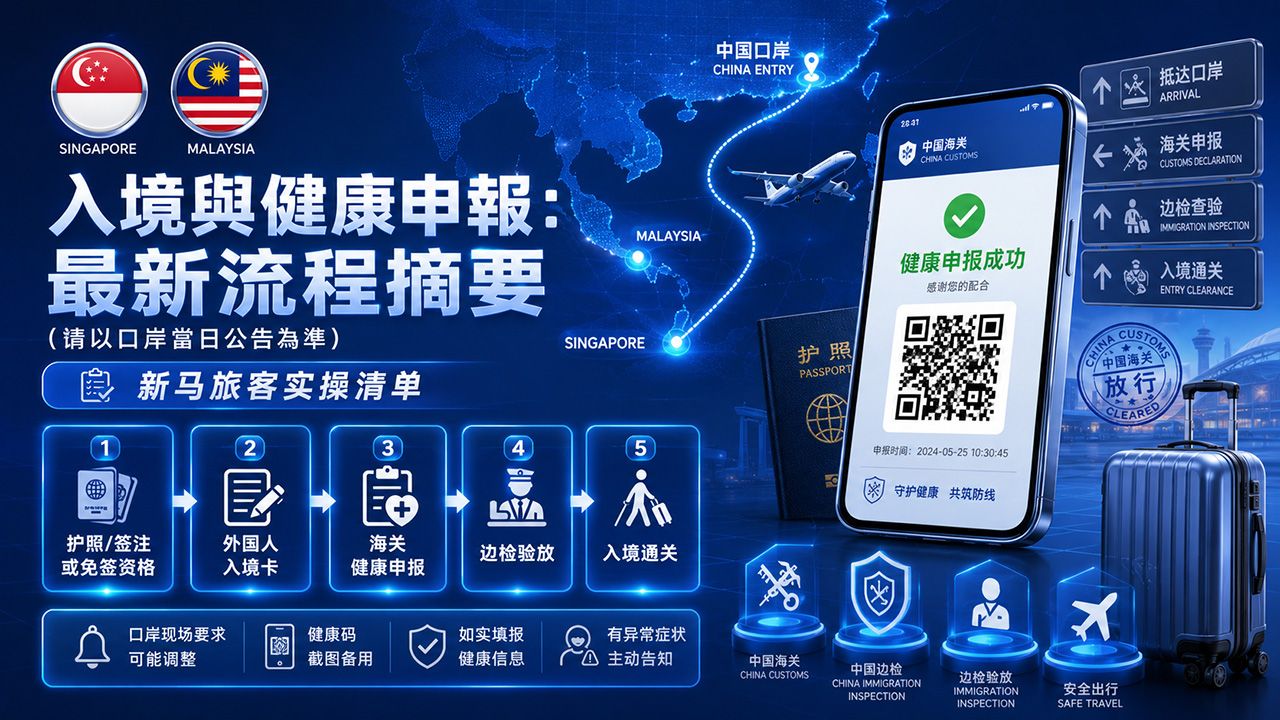
Entry and Health Declaration: Latest Process Summary (Please refer to the port's on-site notice on the day)
Quick answers
- Mandatory QR code scanning canceled: China Customs has officially canceled the mandatory "black code" (Customs Passenger Health Declaration) requirement for inbound travelers.
- Voluntary declaration principle: If you have symptoms such as fever or cough, you must voluntarily declare to customs to receive necessary medical assistance.
- Passport/visa check: Travelers from Singapore and Malaysia should ensure their passport is valid for at least 6 months and confirm eligibility under current visa-free policies.
- Dynamic adjustments: Entry procedures may be adjusted at any time due to public health needs; always follow on-site notices at the port of entry on the day of arrival.
1. Document Preparation: Visa-Free and Visa Policies
Currently, China has implemented very friendly visa-free policies for citizens of Malaysia and Singapore.
Malaysian travelers: Enjoy unilateral visa-free entry, with a stay period typically of 15 or 30 days (depending on the latest announcement).
Singaporean travelers: Enjoy mutual visa exemption, with similarly favorable stay periods.
Tip: Before departure, confirm via the "China Consul" app or official website that your passport type qualifies for visa-free entry.
2. Health Monitoring: From "Mandatory" to "Voluntary"
The once-common "Customs Code (Black Code)" is now history.
No need to scan in advance: Most healthy travelers do not need to fill out complex declaration forms on WeChat mini-programs.
On-site spot checks: Customs retains the right to conduct temperature checks and random inspections at ports.
Important: If you feel unwell during the flight, be sure to inform the cabin crew or customs officers immediately after landing.
3. Customs Clearance Process at Chaoshan Airport (SWA)
Arrival quarantine: Walk through the temperature monitoring area (usually infrared, no need to stop).
Immigration: Have your passport ready. Travelers with new-generation passports can try automated e-gates at some ports (fingerprints must be pre-registered).
Baggage claim: After confirming your luggage, proceed through customs inspection.
Customs spot check: If you are not carrying excessive alcohol, tobacco, or prohibited items, go directly through the green channel (Nothing to Declare).
Summary of Changes in China's Entry Policies
← 左右滑动查看完整表格 →
| Process Item | 2023 and Before | Latest Status in 2026 | ||
|---|---|---|
| Health Declaration (Black Code) | Mandatory, required to fill online in advance and generate QR code | Mandatory declaration canceled, only required for symptomatic travelers |
| Nucleic Acid/Antigen Test Proof | Negative proof required | Not required |
| Port Quarantine Method | Individual QR code scanning and verification, slower process | Contactless infrared temperature check, fast passage |
| Post-Entry Monitoring | May involve home or centralized monitoring | Fully normalized, free travel upon arrival |
FAQ
Q:If I forget to complete the health declaration, will I be denied entry?
A:No. Because the mandatory QR code requirement has been canceled. As long as your passport and visa/visa-free status are valid and you have no significant infectious disease symptoms, you can enter smoothly.
Q:Will customs check my luggage upon arrival at Jieyang Chaoshan Airport?
A:Customs will X-ray all checked baggage. If you are carrying personal items worth more than 5,000 RMB (excluding personal use) or more than 400 cigarettes, you must use the red declaration channel.
Q:Do I still need to wear a mask when entering China?
A:Most public places in China no longer require masks, but in crowded areas like airports and high-speed rail stations, we still recommend wearing a mask for personal health.