Chaoshan (Teochew) lives and breathes food, but three days and two nights is a short window — spend it all queueing at Instagram-famous shops and you will miss what locals actually eat. This guide is not another "must-try list". Instead, it maps each meal to its proper time slot (breakfast, lunch, dinner, supper) across your three days: what to eat, what kind of shop to look for, what to order, and how much to budget per head.
The short answer: schedule food by time slot. Teochew locals often eat five times a day — breakfast, lunch, afternoon tea, dinner, and late-night porridge (ye mu). One rule matters most: put the right dish in the right slot. Beef hotpot belongs to daytime (the best cuts sell out by evening); claypot seafood porridge, cold "darleng" dishes and plain porridge belong to the night; plain congee with sides is a breakfast thing. A workable plan: keep arrival day light (kway teow soup or braised goose rice), devote day two to beef hotpot plus supper, and close day three with braised goose, kueh and souvenirs. For sightseeing, pair this with our
Chaoshan 3D2N itinerary.
Arrival day: kway teow soup or braised goose rice — not hotpot. After a flight you are rarely hungry enough for a full hotpot session. Kway teow soup is Chaoshan's everyday comfort food: beef kway teow with freshly sliced beef and beef balls, pork-offal or seafood versions, around RMB 15–30 per head. Braised goose rice (lo ak) stars the famous Chenghai lion-head goose, around RMB 25–45. If you still have room, try a Chaoshan-style chee cheong fun — unlike the Cantonese version, it comes bathed in braised gravy or shacha sauce. To get your bearings in the old town, see our
Xiaogongyuan cafe and photo map.
Day two breakfast: plain porridge with kiam chye sides. Locals call congee "muay", served with a spread of small dishes — preserved radish omelette, salted vegetables, pickled olives, braised tofu, salted fish, fermented beancurd, peanuts. Light but satisfying, around RMB 10–25. The morning is also a good time to wander a wet market and watch kueh being made fresh.
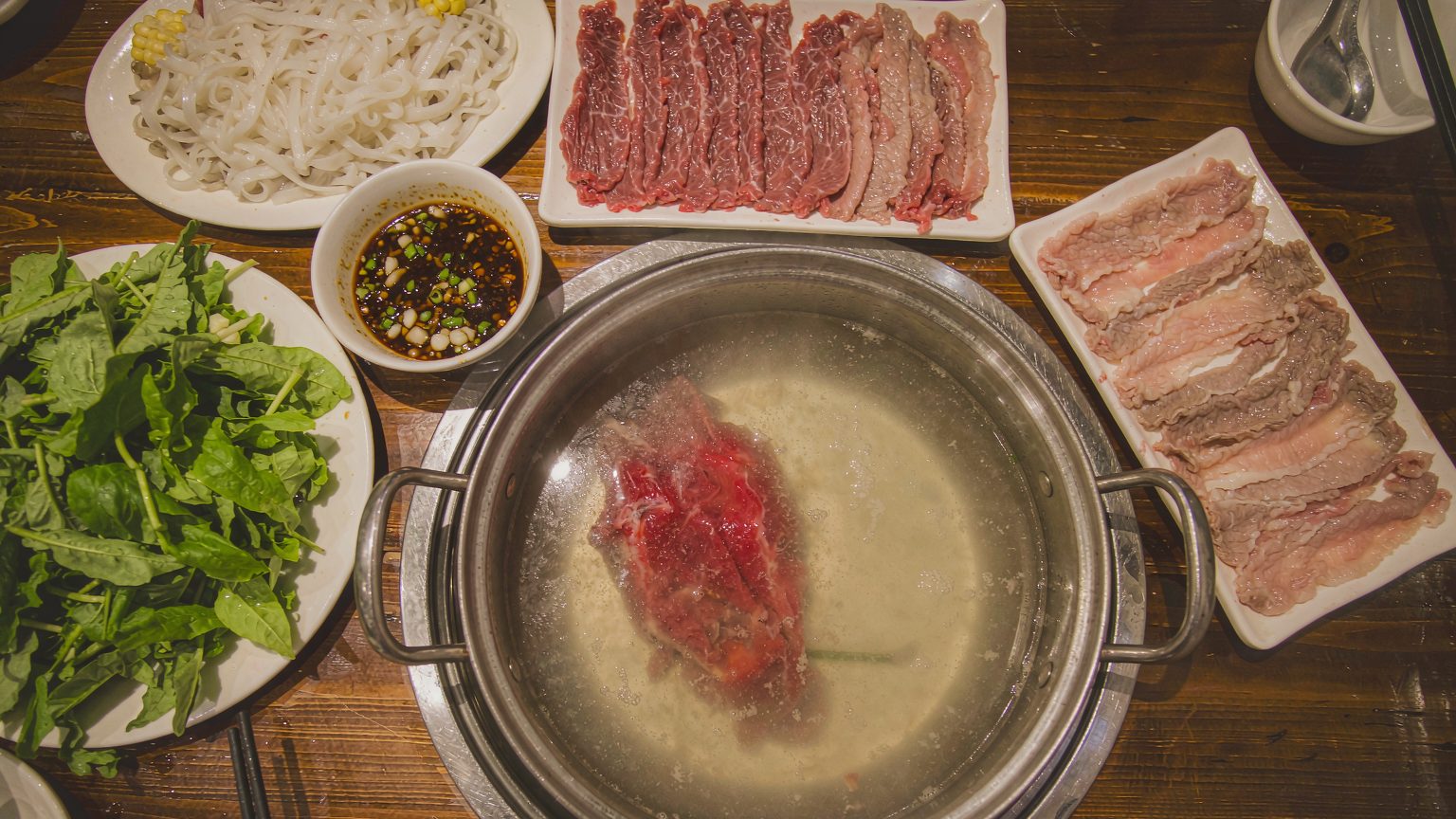
Day two lunch: beef hotpot — what to order and when to go. Beef hotpot is the signature Chaoshan experience, and timing beats shop-picking: the best cuts are all available from late morning to mid-afternoon, while popular parts are often sold out by dinner. Order by cut: diao long (sirloin), diao long ban, si bing, si ren, bo ren (marbled chuck), five-flower tendon, tender meat, fei bi, and for a crunchy bite, chest fat (xiong kou lao). Add beef balls, tendon balls, and finish with kway teow. The broth is clear — locals rarely order split pots; the point is the beef's own flavour. Swirl each slice for 8–12 seconds until just changed in colour, then dip in shacha sauce with celery and garlic. Around RMB 80–150 per head. A full cut-by-cut guide lives in our
Chaoshan beef hotpot guide.
Day two supper: claypot porridge and late-night muay. Chaoshan suppers have two aces: claypot seafood porridge, cooked to order with mud crab, prawns, oysters or geoduck — silky grains, deep seafood sweetness, around RMB 60–120 — and "darleng" cold tables: braised goose platters (meat, liver, webs, wings, blood), fish rice (cold salt-water fish, not actual rice), chilled crab, and oyster omelette, washed down with gongfu tea. Late-night muay — plain congee with sides — is the mildest, safest option. Raw marinated seafood (yim hae; locals joke it is "the poison") is a highlight but carries parasite and stomach risks: skip it for elderly travellers, children and sensitive stomachs, and only try it at well-patronised old shops.
Day three: braised goose, kueh and souvenirs. Close the trip with braised goose ordered by part — meat, liver, webs, wings, blood, intestine — around RMB 30–60 per head. Vacuum-packed goose travels well, but check both customs' latest rules before carrying it across borders. The kueh universe includes red peach kueh, mouse-shell kueh, png kueh, salted kueh and five-spice rolls; Xiaogongyuan in Shantou and Paifang Street in Chaozhou cover most of it in one walk. Souvenirs: lao bing pastry, fermented beancurd pastry, sugar-coated peanuts, Fenghuang dancong tea (for gongfu brewing), and lao xiang huang preserved finger lime fruit — RMB 50–200 covers it.
Ordering pitfalls: three places trips go wrong. First, do not burn hours queueing at influencer shops — the truly good ones hide in old-town alleys with faded signs and fast table turnover; pick shops where locals outnumber tourists and menus are short. Second, with seafood always ask the price first and watch the weighing — confirm live stock, unit price, weighed weight and total before anything hits the pot, to avoid "market price" disputes at billing. Third, go easy on raw marinated and braised items; raw marinade carries risk and braised food is salty and oily — sensitive stomachs should favour cooked dishes and hot soup, and always prefer busy, fast-turning shops.
Budget and timing at a glance. Per meal: beef hotpot RMB 80–150; claypot porridge RMB 60–120; darleng cold dishes RMB 80–150; braised goose rice RMB 25–45; kway teow soup RMB 15–30; porridge with sides RMB 10–25. Across three days and two nights, budget roughly RMB 400–800 per person for food (excluding drinks and souvenirs). Timing: breakfast 7:00–10:00; lunch 11:30–13:30; afternoon gongfu tea 15:00–17:00; dinner 18:00–20:30; supper from 21:30. Chaoshan suppers start late — leave slack after dinner.
Travelling with elderly parents or children. For seniors, go easy on raw marinade and chilli: claypot porridge, plain congee, kway teow soup and steamed seafood are safer, and order clear broth for hotpot with thorough cooking. Children take best to beef balls, fish balls, kway teow, kueh and steamed egg. Two safety notes: shellfish-allergic travellers should avoid oyster omelette, fish rice and raw marinade; peanut and sesame allergy sufferers should check shacha sauce ingredients. For the overall pace with parents, see our
Chaoshan food guide for elderly parents.
FAQ. Is three days enough? Yes — cover beef hotpot, claypot porridge/darleng, braised goose and porridge-with-sides and you have the backbone of Teochew cuisine. Is beef hotpot a must? Strongly recommended once; it is the fastest way to understand Chaoshan's "fresh, clear, original flavour". Can I eat raw marinated seafood? Healthy adults can try a little at busy old shops; pregnant women, seniors, children and sensitive stomachs should skip it. What if I don't speak the language? Point at menus or neighbouring tables, or name the beef cuts directly. Vegetarian or halal? Kway teow, kueh, congee and vegetables offer options; halal restaurants are scarce — search ahead. How much per person? Roughly RMB 400–800 excluding drinks and souvenirs. What can I bring home? Pastries, tea and preserved fruit travel well; fresh goose and fish balls depend on customs rules.
Turn this list into your itinerary: to fit each meal to your arrival time, hotel location and your parents' pace, see our
custom itineraries or
contact us for a free chat.