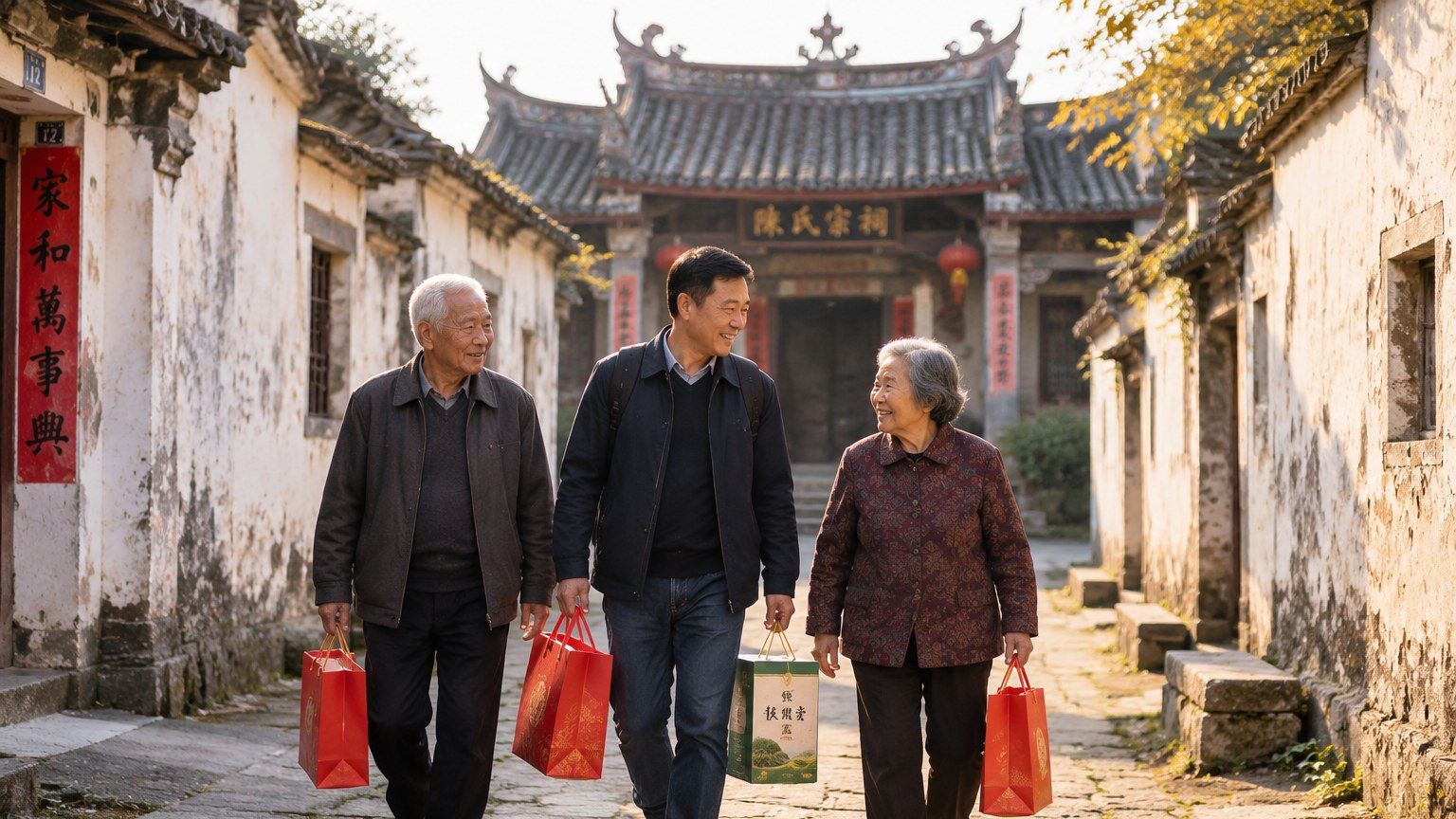
Bringing your parents back to Chaoshan is a trip that has been waiting decades. The hard part is rarely the distance — it is the etiquette. A red packet handed the wrong way leaves an elder quietly uncomfortable; a gift that cannot clear customs never reaches anyone; one wrong step inside an ancestral hall is remembered for years. This guide lists the pitfalls in three areas: red packets, gifts, and hall etiquette.
One caveat first: customs differ from village to village, and even between villages in the same township. What follows are the common practices. Confirm with your ground operator or the clan elders before you go — one question saves a great deal of awkwardness.
The short version: etiquette is about making people comfortable, not spending more
Red packets are about sincerity, not thickness. New notes, a red envelope, handed and received with both hands; avoid amounts containing the number 4, and use even numbers for happy occasions. Paying a village insider a "handling fee" is taboo — proper introductions and courtesy are the only legitimate route, as we explain in
Root-Seeking in Chaoshan: What a Local Ground Operator Can and Cannot Do.
Gifts are prepared per household, not per person. If you visit three homes in one day, the three gifts should be similar in value — better to bring less than to visibly play favourites. And inside the ancestral hall, follow the clan elders: who enters first, how many incense sticks, how many bows. When unsure, be half a beat slower — slower is always safer than wrong.
Red packets: who, when, and how much
Who: elderly relatives (especially your parents' generation and above), clan elders you are meeting for the first time, and young children. Distant relatives present need not all receive one; but if you do give, do it naturally — never hand them out in public or compare amounts.
When: after the greetings and the first round of tea, once everyone is seated. Not at the doorway, and not after the third round of drinks at the table. Around Chinese New Year, the packet for elders is called yasuiqian (lucky money) and the one for children is a hongbao — different words, same courtesy.
How much: as a guide, RMB 200–800 for elders and RMB 20–100 for children, adjusted for closeness and local habit. Avoid amounts containing 4; use even numbers such as 200, 600 or 800.
How to hand it over: new, flat notes in a red envelope; give and receive with both hands, with a blessing as you do. Accept whatever elders give back — sweets, tea — with both hands and thank them on the spot. A white envelope, used for funerals, must never be used for a gift.
Honestly: when in doubt, keep it modest. Chaoshan elders care far more about the sincerity of your visit than the thickness of your packet.
Gifts that look right: five safe choices
Food from home, properly packaged: Malaysian white coffee, Nanyang-style biscuits, kaya spread — things with a story travel best, provided they clear customs (see the next section).
Tea and teaware: Chaoshan people drink gongfu tea, so a decent box of tea is always appropriate — but Chaoshan's own dancong is world-famous, so do not pass off cheap tea as a gift; it will cost you face.
Nanyang medicated oils and health products: Tiger Balm, wind oil and similar items have a good reputation among older Chaoshan folk — practical, unshowy, and almost risk-free.
For the children: stationery, sweets, chocolate, stickers. One small bag is enough and quickly melts the awkwardness of a first meeting.
Gifts to avoid: clocks (associated with funerals), umbrellas (parting), pears (separation) and knives or scissors (cutting ties); white wrapping and white flowers are inappropriate for gifting. On numbers, even is for happy occasions, odd is for funerals.
Gifts that will not clear customs
This is the most overlooked and most disappointing step. Under the Chinese customs and agriculture authorities' list of prohibited animal and plant products for inbound travellers, you cannot bring in: meat and meat products (jerky, meat floss, sausages, instant noodles with meat), eggs and egg products (salted eggs, century eggs, egg rolls), fresh fruit and vegetables, seeds and seedlings, and bird's nest (except canned). Singapore bak kwa, bak kut teh sachets containing meat, and home-made salted eggs all stay out of the suitcase. What you can bring: properly packaged sweets and biscuits, coffee, tea, canned food. Check the latest list on the
General Administration of Customs of China or
China Qiaowang before you fly — a few minutes saves a great deal of trouble.
One more note: medicated oils and health products for your elders should be within reasonable personal quantities. Do not pack them by the carton, or they may be treated as commercial goods.
Ancestral hall etiquette: nine steps from doorstep to farewell
-
Tidy yourself at the door. Remove hats and sunglasses, silence your phone, dress neatly with sleeves and a collar; slippers and shorts are out of place.
-
Do not step on the threshold. Elders say the threshold is the shoulders of the ancestors — step over it, never stand on it.
-
Follow the clan elders. Who enters first and who offers incense first is their call. Walk half a step behind your elders; do not push to the front.
-
Three incense sticks. Hold them with both hands at eyebrow height, bow, then place them in the burner. Never blow out a flame — wave it out gently.
-
Keep the bowing simple. Follow the elders' lead for bows or kneeling; doing it properly matters more than doing it theatrically.
-
Stay quiet. No phone calls, no chatting, no children running around the hall.
-
Do not cross boundaries. Do not go behind the shrine, do not climb on the offering table, do not handle the genealogy or ancestral tablets.
-
Ask before photographing. Ask first; even then, do not photograph ancestral tablets or the pages of the genealogy.
-
Thank them before you leave. Thank the elders, and place your incense money in the donation box without fuss.
Four things elders most often get wrong: taking loud phone calls or livestreaming inside the hall; asking publicly what the genealogy is "worth" or how the ancestral house will be divided; promising on the spot to "pay for restoring the hall"; and talking about how much you spent to arrange things. Say any of those and every courtesy before it is undone.
Hosting and returning gifts: who pays, and how to reciprocate
Chaoshan people value hospitality, and fighting over the bill is normal. Rather than fight, plan ahead: have your operator book a table in advance (a town restaurant or a beef hotpot both work well) and host the meal yourself. If your relatives insist, accept gracefully, then host the second meal or give a gift instead.
Reciprocate what you receive. When elders press sweets, tea or home-made kueh on you, return a small gift for their children and the courtesy is complete.
The most lasting thank-you comes later. Once you are home, print the family photo and mail it back; restore an old photograph and send it to the genealogy keeper. That gesture outlasts any red packet given on the day.
On tipping: there is no tipping culture in Chaoshan. A sincere thank-you to your driver or guide is enough; if you want to express more, a gift is more appropriate than cash.
Your one-week-before checklist
Documents and entry: keep at least six months' validity on your passports; confirm the latest visa or visa-free policy for China; store your flights, itinerary, and the names and contacts of the villages you will visit both on your phone and on paper.
Medication for your elders: bring chronic-illness medication for the length of the trip plus three days, keep it in the original packaging with the prescription (Chinese or bilingual if possible), and carry it in your hand luggage, never checked in. Pack spare batteries for blood-pressure and glucose monitors.
Packing gifts: split them into separate small bags, one per household, with the address form written on the outside ("Ah Beh", "Lao Sim"). Liquids and powders go in checked luggage, alcohol within the allowance, and jerky or salted eggs stay at home.
Communicating the schedule: tell both your elders and your hosts in advance which village you are visiting on which day, whom you are meeting and at what time — do not change it on the day. One village a day at most, with time to sit down for a meal.
Language and accompaniment: if your parents do not speak Teochew, arrange a companion who speaks both Teochew and Mandarin. Inside the hall, let the elders talk about old times first while the younger generation takes photos and notes — that is what makes the occasion flow.
FAQ: nine things to confirm before you travel
Q1. How much should a red packet be? RMB 200–800 for elders and RMB 20–100 for children is the usual range, adjusted for closeness and local habit. If unsure, ask your operator — or give modestly; sincerity matters more than amount.
Q2. How many gifts should I prepare? Per household, not per person. Every home you will visit gets one, of similar value — and if you visit several homes in one village, keep them balanced.
Q3. Can I bring bak kwa or bird's nest into China? No. Meat products, egg products, fresh fruit and bird's nest (unless canned) are on the prohibited list; always check the latest customs notice.
Q4. What should we wear inside the hall? Neat clothing with sleeves and a collar. No slippers, shorts or tank tops, and no flashy jewellery.
Q6. What if relatives insist on paying? Accept, thank them, then host the next meal or give a gift. No need to fight over it.
Q7. How should I offer to donate towards restoring the hall? Incense money goes in the donation box. For anything larger, go through the clan elders or the hall committee formally, keep the receipt, and never promise on the spot or hand over cash privately.
Q8. Can we bring medication for our parents' chronic conditions into China? Yes, within reasonable personal quantities. Keep it in the original packaging with the prescription or a doctor's note, so you can explain it clearly if asked; do not carry medication for other people, and do not repack it loose.
Q9. What if our parents do not share a language with the villagers? Most elderly villagers speak Teochew. If your parents speak only Mandarin or English, arrange a bilingual companion; write down anything important in advance and have it interpreted sentence by sentence — far more effective than letting them improvise.
Sources and official channels
For the quarantine and gift-related information in this article, check these official channels: the
General Administration of Customs of China (prohibited inbound items list),
China Qiaowang (overseas Chinese affairs and visiting family), and the
Shantou Municipal Government (administrative divisions and historical place names). Clan customs vary considerably from place to place — the elders and the hall committee are the final word.
Final word
Bringing your parents back to Chaoshan is a road they have waited decades to walk, and a chance to hand the family tradition to the next generation. Hand the red packets steadily, prepare the gifts evenly, follow the elders inside the hall — and then simply enjoy walking it together. If you would like the arrangements with the village committee, the clan elders and the hall handled in advance, take a look at
how we structure a root-seeking trip, or
send us your plans for a free preliminary assessment.