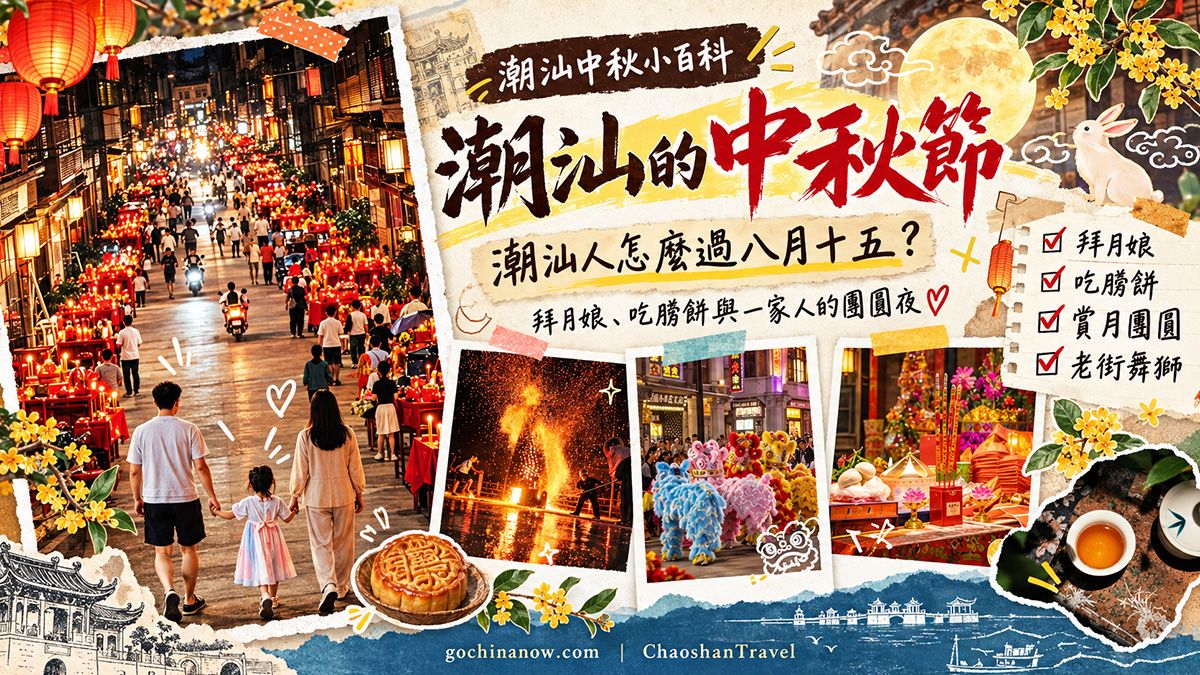
How is Mid-Autumn Festival celebrated in Chaoshan?
If you only come to Chaoshan during the day, it may not feel all that different from Mid-Autumn in other cities.
Mooncakes are displayed in shops, pomelos and festive foods appear in markets, and all kinds of Mid-Autumn gift boxes start showing up on the streets.
The really interesting part comes at night.
After the sun goes down, some old urban districts, villages, and families that still keep traditional customs move tables to their doorsteps, courtyards, or other relatively open spots.
The table is wiped clean.
Lao bing is set out.
Candies are set out.
Seasonal fruits such as pomelos and pomegranates are also prepared.
After the moon rises, the family begins "bai yue niang" (worshipping the Moon Lady).
This is the August 15th remembered by many Chaoshan people.
The Shantou municipal government's earlier report on the Mid-Autumn customs of Wuqiao Island in the old urban area recorded local residents setting up tables in front of their homes after dinner, using mooncakes, crispy sugar, honey pomelos, custard apples, pomegranates, and other offerings to "bai yue niang," after which adults drank tea and chatted while children played in the streets and alleys.
This is also the best entry point for understanding Chaoshan Mid-Autumn:
It is not just the single ritual of "moon worship," but rather a night that brings together prayers, reunion, food, gongfu tea, and neighborhood life.
- What is the "bai yue niang" that Chaoshan people talk about?
In Chaoshan, one of the most recognizable Mid-Autumn night customs is:
Bai yue niang.
"Yue niang" is a more affectionate folk term for the moon in Chaoshan.
On the evening of the 15th day of the eighth lunar month, after the moon rises, some families set up an offering table in front of the door, in the courtyard, on a balcony, or in another suitable place to worship the moon.
The specific rituals and offerings vary because of:
Shantou
Chaozhou
Jieyang
Different townships
Different family traditions
So there is no fixed procedure that is "exactly the same for every Chaoshan household."
But the core of "setting out offerings to pray when the moon is full, then enjoying the moon together as a family" can still be seen in many places.
- What is placed on a Chaoshan Mid-Autumn offering table?
If you walk into the old alleys of Chaoshan on Mid-Autumn night, you may sometimes see tables set up in front of one home after another.
The tabletop will not have only mooncakes.
Common offerings may include:
Chaoshan-style lao bing
This is one of the most representative stars of Mid-Autumn.
Sugar foods and crispy sugar
Common in traditional festivals.
Pomelo
Mid-Autumn is exactly the season when pomelos flood the market.
Pomegranate
Also a seasonal fruit that may appear on traditional offering tables.
Local fruits such as custard apple
Different families prepare according to seasonal fruits and their own habits.
In Shantou's official record of "bai yue niang" on Wuqiao Island, offerings such as mooncakes, crispy sugar, honey pomelos, custard apples, and pomegranates are explicitly mentioned.
Of course, many families have simplified things now.
Some prepare in a very traditional way, while others just set out a few fruits and mooncakes.
What matters is not how many things must be on the table.
It is:
When the moon is full on August 15th, the family still remembers to sit together.
- Why are Chaoshan mooncakes called "lao bing"?
When talking about Chaoshan Mid-Autumn, one character is unavoidable:
Lao.
Many first-time visitors do not even know how to pronounce it.
In the context of Chaoshan food, "lao" is related to animal fat. Traditional Chaoshan-style mooncakes use lard to make the pastry or filling, so Chaoshan people customarily call this kind of mooncake:
Lao bing.
Materials on Chaoshan baked goods published in 2026 by the Overseas Chinese Affairs Office of the People's Government of Guangdong Province point out that the most common traditional mooncake in Chaoshan at Mid-Autumn is lao bing, and that Guiyu, Yixi, and Sunan have formed quite representative traditional lao bing-making styles.
- What is the difference between Chaoshan lao bing and ordinary mooncakes?
For people eating Chaoshan-style lao bing for the first time, the most obvious impression is usually:
Flaky.
It is not the same texture as the softer, more oily Cantonese-style mooncake crust.
Traditional Chaoshan-style lao bing emphasizes flaky layers.
After cutting it open, the pastry has clear layers.
Common traditional fillings include:
Mung bean paste
Black bean paste
Taro paste
Crystal filling
Double-cooked filling
In recent years, different flavors such as salted egg yolk, aged preserved tangerine, and dancong tea have also developed.
Among these, names like "crystal" and "double-cooked" may be very unfamiliar to visitors from elsewhere.
This is precisely what makes traveling in Chaoshan interesting.
You do not have to ask only:
"Which mooncake is the most expensive?"
You can walk directly into a local bakery and ask:
"Which one here is your traditional lao bing?"
Often, that is enough to start a very Chaoshan-flavored conversation.
- Eating lao bing at Mid-Autumn is not just about "eating"
For older generations of Chaoshan people, lao bing also has a strong festival identity.
It can be used to:
Worship the moon;
Share and eat with the family;
Give to relatives;
Give to elders;
And it can also be mailed to family far away.
A 2026 Chaoshan Mid-Autumn feature by the Overseas Chinese Affairs Office of the People's Government of Guangdong Province mentions that Mid-Autumn is a peak period for sales of Chaoshan baked goods. People buy lao bing not only for worship and moon viewing, but also to give to relatives and friends; overseas Chaoshan communities likewise continue the tradition of using mooncakes to express feelings for their hometown.
Chaoshan itself is also a famous hometown of overseas Chinese.
So behind a piece of lao bing, there is often another word as well:
Homesickness.
When people have gone to Hong Kong, Thailand, Singapore, Malaysia, or even farther places, eating familiar Chaoshan-style baked goods on August 15th may still make them think of that tea table at home.
- What is the best way to eat lao bing? With gongfu tea
If you eat lao bing in a Chaoshan home, there is very likely a pot of tea nearby.
Because for Chaoshan people:
Pastries are a very natural "tea companion."
Chaoshan-style lao bing is flaky, fragrant, and sweetly rich.
Gongfu tea, meanwhile, has tea aroma and a sweet aftertaste.
A small piece of lao bing and a small cup of tea is a far more comfortable way than eating a whole mooncake at once.
When introducing Chaoshan-style lao bing, the Overseas Chinese Affairs Office of the
People's Government of Guangdong Province also specifically mentions the tradition of Chaoshan baked goods as a "tea companion" for gongfu tea.
If you travel to Chaoshan during Mid-Autumn, you can treat:
Eating lao bing + drinking gongfu tea
As a complete experience.
Rather than ending after buying mooncakes to take away.
- Mid-Autumn in a Chaoshan family usually starts during the day
The Mid-Autumn ritual does not suddenly appear at night.
Preparation has already begun during the day.
Buying fruit in the market.
Picking up pre-ordered lao bing from the bakery.
Buying tea.
Preparing dinner.
Family members working elsewhere also try their best to rush back.
If the family still keeps the traditional moon worship habit, the evening offerings also need to be prepared in advance.
So for many Chaoshan families:
The truly important thing about Mid-Autumn is not going out to have fun, but coming back.
Come back to eat.
Come back to sit for a while.
Come back to drink tea.
- Mid-Autumn dinner is the "reunion meal" of the day for Chaoshan people
There is no unified standard menu across families.
Chaoshan does not have a required "eight Mid-Autumn dishes" that everyone must follow.
Some eat at home.
Some book a table at a restaurant.
Some prepare seafood.
Some eat braised goose.
Some simply have the family make a few dishes.
Young families today are also changing how they celebrate.
But "the whole family trying to eat a meal together" remains the most important part.
So if visitors come to Chaoshan at Mid-Autumn, there is no need to deliberately look for so-called:
"Authentic Chaoshan Mid-Autumn set meals."
What is truly worth experiencing is instead a normal but well-made Chaoshan meal.
For example:
Chaozhou braised goose
Raw-marinated or cooked seafood
Fish rice
Chaoshan beef
Seasonal vegetables
Chaozhou cuisine
After eating, return to the tea table.
- After worshipping the Moon Lady comes the time many people like most
After the formal ritual ends, Mid-Autumn night slows down.
The fruit can be eaten.
The lao bing is cut open.
The tea is brewed.
Adults sit together and chat.
Children run around nearby.
Neighbors chat a few words when they run into each other.
This is also why Mid-Autumn in the old urban districts has such flavor.
In Shantou's official reports, Mid-Autumn night on Wuqiao Island is exactly this kind of scene: after residents worship the moon, adults drink tea and talk, children play in the streets and alleys, and neighbors enjoy the moon together.
This experience is not like a large performance.
There is no fixed start time.
And there is no ticket.
It is more like local life naturally opening a door on a certain night.
- Why does Chaozhou also "burn tile towers" at Mid-Autumn?
If we expand from family Mid-Autumn to public folk customs, Chaozhou has another highly recognizable tradition:
Burning tile towers.
Tile towers are usually built from bricks and tiles, with firewood and straw placed in the middle; once lit, they form a tower of fire.
The Overseas Chinese Affairs Office of the Guangdong Provincial Government's introduction to Guangdong Mid-Autumn folk customs points out that in Chaozhou, besides eating mooncakes, taro, and worshipping the Moon Lady, there are also traditional customs such as burning tile towers; later this custom also carried the symbolic meaning of praying for a prosperous life and celebrating a good harvest.
It should be specially noted:
Burning tile towers is not a Mid-Autumn activity that every Chaoshan family carries out today.
It exists more in the traditional folk customs and festival activities of certain places.
Therefore, when writing about Chaoshan culture, it should not be described as:
"Every Chaoshan family burns towers at Mid-Autumn."
That is not accurate.
- Can you still see Chaoshan Mid-Autumn tower burning now?
Yes, but it is better understood as:
A folk display and community tradition in specific areas or festival activities.
For example, during the 2023 Mid-Autumn and National Day holiday, cultural tourism activities announced by Shantou officials explicitly included "Mid-Autumn Chaoshan custom tower burning and moon viewing."
The specific year and place depend on that year's official event arrangements.
If you come to Chaoshan specifically to see tower burning, it is not advisable to go directly to a village based only on videos from several years ago.
Before departure, it is best to check:
(Shantou Municipal Bureau of Culture, Radio, Television, Tourism and Sports: official festival activity information)
This is more reliable.
- What other foods are there for Chaoshan Mid-Autumn?
Besides lao bing, Chaoshan baked goods are very rich during Mid-Autumn.
For example:
Crispy dumplings
Their shape curves like the moon, and they are one of the common tea companions in Chaoshan at Mid-Autumn. The Chaoshan Mid-Autumn food feature by the Overseas Chinese Affairs Office of the Guangdong Provincial Government also lists crispy dumplings as a food with local Mid-Autumn characteristics.
Fermented bean curd pastry
Seasoned with fermented bean curd and combining peanuts, sesame, sugar, and other ingredients, it is a quite recognizable traditional pastry in Chaozhou.
Various traditional Chaoshan pastries
Different towns and different bakeries have their own ways of making them.
So if you come to Chaoshan during Mid-Autumn, rather than buying ten boxes of the prettiest gift packaging at once, it is better to go to a local traditional bakery:
Buy a small amount,
Try slowly.
It will be more interesting.
- Why does Chaoshan Mid-Autumn feel especially like "home"?
This is also related to Chaoshan's social and cultural structure.
Here there have long been very strong:
Family values
Local ties
Clan connections
Overseas Chinese hometown culture
The theme of "reunion" at Mid-Autumn is especially natural in such a social environment.
Many members of Chaoshan families have long lived in:
Guangzhou,
Shenzhen,
Hong Kong,
Or overseas.
When Mid-Autumn truly arrives, the most weighty thing is still:
Going home.
There is no need to hold a very complicated ritual.
The family eating at the same table is the festival.
- Do young Chaoshan people still worship the Moon Lady now?
Some do, but it cannot be generalized.
Today's Chaoshan, like the rest of the country, is constantly changing in lifestyle.
In urban apartments, some families:
Fully preserve the traditional ritual;
Some families simplify the process;
And some young families mainly just gather for a meal, give mooncakes, and enjoy the moon.
So a more accurate statement should be:
"Bai yue niang is still one of the representative Mid-Autumn customs in Chaoshan."
Rather than:
"All Chaoshan people must worship the Moon Lady at Mid-Autumn."
Reports by the Shantou government in recent years can still record community residents collectively preserving this tradition, which also shows that this folk custom does not exist only in books today.
- Where can visitors go to feel the festival atmosphere in Chaoshan at Mid-Autumn?
If you want to combine Mid-Autumn travel with Chaoshan culture, you can include several areas in your route.
Shantou Xiaogongyuan Historical and Cultural District
Suitable for:
Seeing the old city with arcade buildings
Eating Chaoshan snacks
Buying traditional baked goods
Feeling the festival atmosphere of the district
In recent years, Shantou's Mid-Autumn holidays have also launched cultural tourism activities combining intangible cultural heritage, folk customs, and making kueh. The 2025 Shantou Mid-Autumn Cultural Tourism Carnival included fish lantern dance, Chaoshan folk custom displays, and hands-on experiences making red peach kueh and rat herb kueh.
Chaozhou Ancient City
Chaozhou at Mid-Autumn is especially suitable for a slow evening walk.
You can arrange:
Paifang Street
→ Guangji Tower
→ Along the Han River
→ Gongfu tea
Rather than rushing through a dozen sights starting in the morning, it is better to slow the pace.
Nan'ao Island
If you like natural scenery, you can arrange Nan'ao Island during the day and return to the city at night, or enjoy the moon on the island according to your accommodation plan.
When the weather is good, islands and Mid-Autumn go very well together.
However, whether seaside activities are suitable during Mid-Autumn still depends on weather, waves, and typhoon information.
- Coming to Chaoshan at Mid-Autumn requires attention to holiday crowds
For visitors, Mid-Autumn is both a good time to experience folk customs and also means:
This is peak travel season.
On the eve of Mid-Autumn in 2026, relevant Shantou departments had already carried out special regulation of prices in the accommodation, catering, and tourism markets, and explicitly required accommodation, catering, tourism, and other operators to clearly mark prices in accordance with the law.
So if you plan to come to Chaoshan at Mid-Autumn, it is recommended to handle in advance:
High-speed rail
Hotels
Vehicles for Nan'ao Island
Popular restaurants
Family chartered cars
Especially for larger families, it is not recommended to look for a car only after arriving at Chaoshan Station.
- How many days are suitable for a Mid-Autumn trip to Chaoshan?
If it is your first time, you can consider 3–4 days.
3-day itinerary
Day one: Shantou
Xiaogongyuan, the old urban area, food, traditional bakeries.
Day two: Chaozhou
Chaozhou Ancient City, Guangji Bridge, Paifang Street, gongfu tea.
Day three: Nan'ao Island or an in-depth Shantou tour
Decide according to your return time.
4-day itinerary
You can arrange:
Day 1: Shantou old city
Day 2: Nan'ao Island
Day 3: Chaozhou Ancient City
Day 4: Chaozhou / Jieyang + return trip
For Mid-Autumn travel, it is best not to pack every day too full.
What is truly worth experiencing is often:
Sitting down to drink tea,
Waiting for the moon to rise,
And seeing how local people spend this festival.
- Can visitors participate in "bai yue niang"?
If you are in the home of relatives or friends and the host invites you, of course you can experience it together.
But if you are only passing by and see a stranger's family worshipping, the more appropriate approach is:
Keep a polite distance.
Do not:
Enter someone's doorway directly;
Pick up offerings casually;
Take close-up photos of people;
Interrupt the ritual to ask for group photos.
Folk customs are first the lives of local people.
Only second are they tourism content for visitors.
If you want a systematic Chaoshan folk custom experience, you can choose a local cultural guide and have someone familiar with local customs introduce it.
- What is the biggest difference between Chaoshan Mid-Autumn and other places?
If it must be summed up in one sentence:
Mid-Autumn in Chaoshan is more like inviting the "moon" to your doorstep.
Visitors from the north may first think of:
Moon viewing, mooncakes.
The Cantonese region also has its own rich Mid-Autumn lantern customs.
But in the lives of Chaoshan people:
Setting out a table,
Worshipping the Moon Lady,
Eating lao bing,
Brewing gongfu tea,
And the family sitting at the door chatting,
Together form a set of life scenes with strong local identity.
None of these things is especially grand.
But put together, they are very Chaoshan.
- Common questions about Chaoshan Mid-Autumn FAQ
Q1: How do Chaoshan people spend Mid-Autumn Festival?
Chaoshan Mid-Autumn usually revolves around family reunion, moon worship, eating mooncakes, and moon viewing. Some families keep the tradition of "bai yue niang," setting out lao bing, sugar foods, and seasonal fruits on Mid-Autumn night to worship the moon and pray, after which the family eats pastries, drinks gongfu tea, enjoys the moon, and chats.
Q2: What is Chaoshan "bai yue niang"?
"Bai yue niang" is one of the representative Mid-Autumn folk customs in the Chaoshan region. Simply put, it means setting out offerings to worship the moon and pray on the evening of the 15th day of the eighth lunar month.
The specific offerings and procedures differ according to region and family tradition.
Q3: What mooncakes do Chaoshan people eat at Mid-Autumn?
The most locally distinctive is:
Chaoshan-style lao bing.
Traditional lao bing emphasizes flaky pastry, with common fillings such as mung bean paste, black bean paste, taro paste, crystal, and double-cooked.
Q4: Why do Chaoshan people drink gongfu tea at Mid-Autumn?
Chaoshan baked goods themselves have a tradition of serving as a "tea companion" for gongfu tea.
Lao bing is sweet, fragrant, flaky, and rich; enjoying it with Chaoshan tea such as dancong is also a very typical local way to eat.
Q5: Do Chaoshan people burn towers at Mid-Autumn?
Chaozhou and some Chaoshan areas have a tradition of burning tile towers, but not all places and all families carry it out.
Today some tower-burning activities appear more in the form of village traditions or public folk activities.
Q6: Besides mooncakes, what else do Chaoshan people eat at Mid-Autumn?
Depending on region and family habits, there may also be:
Crispy dumplings, fermented bean curd pastry, sugar foods, pomelos, pomegranates, and more.
Among them, crispy dumplings and fermented bean curd pastry are also traditional baked goods with obvious Chaoshan characteristics.
Q7: Is Mid-Autumn suitable for traveling to Chaoshan?
Yes.
It is especially suitable for visitors interested in:
Chaoshan culture,
Food,
Ancient cities,
Traditional folk customs.
But Mid-Autumn is a holiday travel period, so hotels and transportation should be arranged in advance.
Q8: At Mid-Autumn in Chaoshan, should I go to Shantou or Chaozhou?
For a first visit, it is recommended to go to both.
Shantou is better for experiencing:
The old urban area, overseas Chinese hometown culture, food, and modern city life.
Chaozhou is better for experiencing:
The ancient city, traditional architecture, gongfu tea, and a stronger historical atmosphere.
If you have 3–4 days, you can also add Nan'ao Island.
- If you want to truly understand Chaoshan, Mid-Autumn is a very good time
Many travel guides will tell you:
When going to Chaozhou, you must see Guangji Bridge.
When going to Shantou, you must stroll through Xiaogongyuan.
When going to Nan'ao, you must go around the island.
Of course, none of that is wrong.
But if you happen to come to Chaoshan at Mid-Autumn, you will see another kind of Chaoshan.
Not the Chaoshan inside scenic areas.
But the Chaoshan in daily life.
Bakeries are busier than usual.
Fruit stalls are full of pomelos.
People carry gift boxes to visit relatives.
At night, an extra table appears at the doorstep.
After the moon rises, the family sits down to drink tea.
At that moment, you may truly understand:
Why Chaoshan people value "ga gi nang" (our own people) so much.
Conclusion: Chaoshan Mid-Autumn, in the end, is still "coming back for a meal"
Mid-Autumn has arrived.
The lao bing has been bought and brought home.
The tea is ready too.
The fruit is washed.
The table is set out.
Waiting for the moon.
Waiting for family to come home.
Modern life has changed many Chaoshan traditions.
Not every young person will worship the moon completely in the way of the older generation, and not every place still keeps festival customs like burning tile towers.
But one thing rarely changes:
On August 15th, those who can go home still try their best to go home.
After dinner, adults pour tea.
The mooncake is cut into several small pieces.
The elders talk about the past.
Children play nearby.
Look up, and there is the moon.
This is probably the most moving part of Mid-Autumn in Chaoshan—
It is not putting tradition in a museum for people to look at,
But rather that many traditions, even today,
Still hide within a dinner table, a pot of tea, and the life of a family.
If you want to know Chaoshan further during your travels, you can continue to view:
For visitors coming to Chaoshan for the first time at Mid-Autumn, rather than rushing through many sights in one day, it is better to leave yourself one evening.
Find a place,
Eat a piece of lao bing,
Brew a pot of tea,
Look at the moon.
That night may make Chaoshan easier to remember than checking off three more sights.
Authoritative information references:
Shantou Municipal People's Government: record of the traditional folk custom of "bai yue niang" on Wuqiao Island in the old urban area, with detailed accounts of Mid-Autumn offerings, moon viewing, tea tasting, and family reunion scenes.
Note: Chaoshan is a vast region, and Mid-Autumn customs differ among Shantou, Chaozhou, Jieyang, and different townships and families. This article describes representative Chaoshan Mid-Autumn traditions and does not mean that all Chaoshan families celebrate according to exactly the same procedures.